
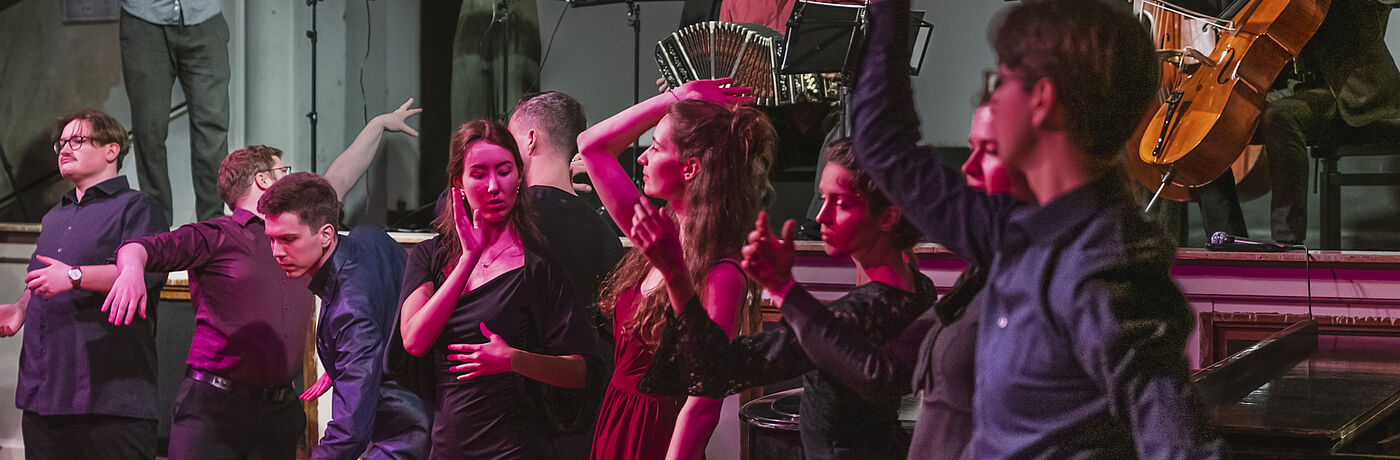
Rhythmics/EMP (Elementary Music Pedagogy)
Rhythmics / EMP, also known as REMP, means studying an interdisciplinary area that provides advanced and specific professional qualifications in the areas of music and movement. This includes linguistic, instrumental, dance and choreographic training.
Training diverse, practical, individual
The Bachelor's program in Rhythmics/Elementary Music Education combines vocal, instrumental, dance, and pedagogical content that prepares students for practical teaching of music and movement and is geared toward the curriculum offered by music schools and independent organizations. Further pedagogical specializations are possible through individual profile development.
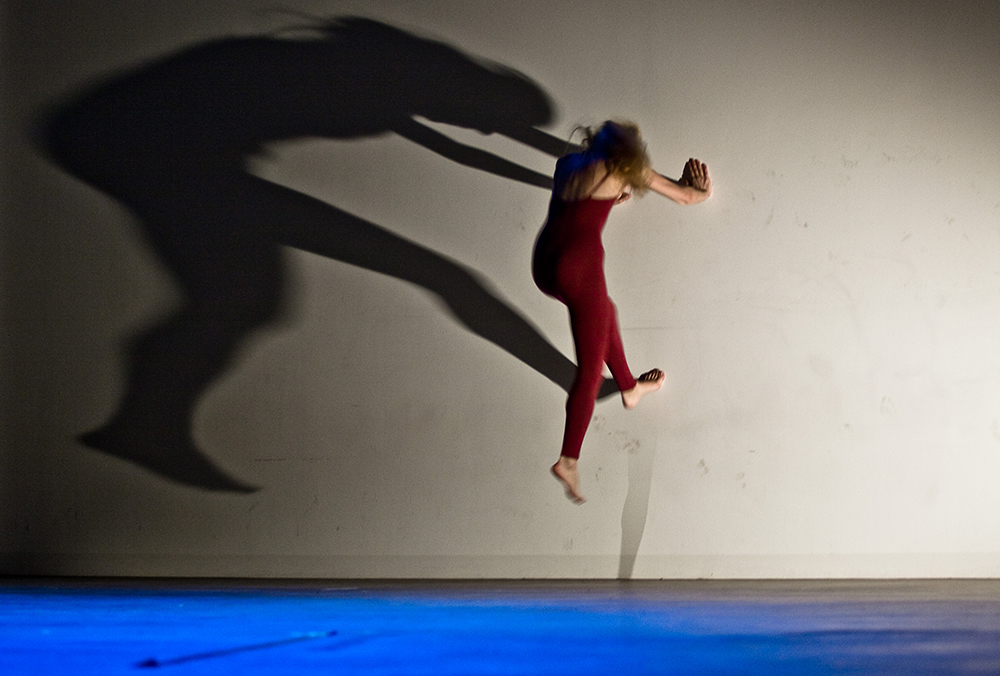
The program offers a diverse field of networking between music and movement. In the work processes of rhythmics, improvisational and creative skills are developed to translate music into visible movement and, in turn, to transform movement into aural experiences.
The program is aimed at all those who are musically, dance-wise, creatively, and pedagogically ambitious and enjoy working in and with groups, who have the appropriate qualifications and who pass the entrance exam.
A special focus is on observation opportunities and teaching practice in the junior development class, in the areas of early childhood education and basic training as well as in elementary instrumental lessons and at the Saxon State Gymnasium for Music in the subject of rhythmics.
Making Music in the Countryside Concert Series
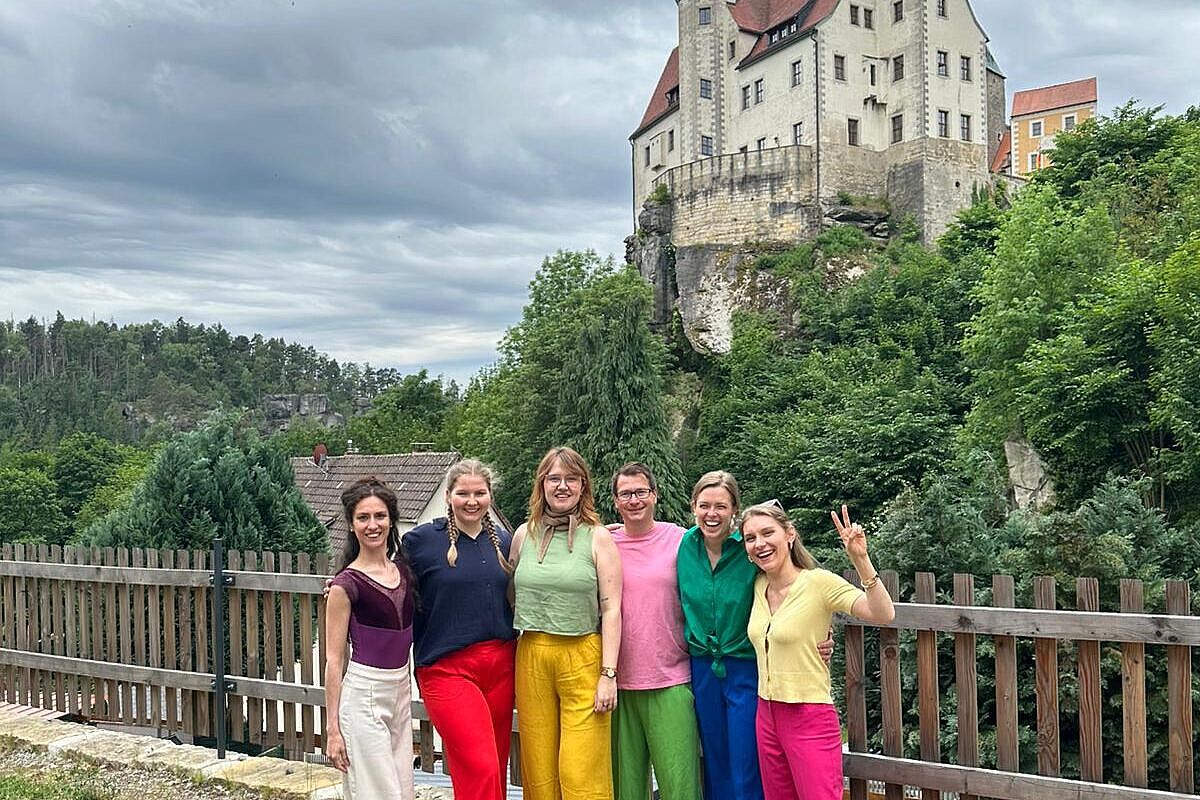
In 2020, the university initiative "Making Music in the Countryside" was launched. Since then, students from the Dresden University of Music (HfMDD) have been performing concerts and performances together with music students from the rural region.
Venues include the "Altes Amtsgericht" (Old District Court) in Stolpen, Struppen Castle and Thürmsdorf Castle in Saxon Switzerland, Bieberstein Castle near Freiberg, Hohnstein Castle, the Evangelical Free Church in Weißwasser, and Seifersdorf Castle in the Seifersdorf Valley. This has led to closer ties with the music schools of Saxon Switzerland, Dreiländereck, and Bautzen (Radeberg).
The initiative aims to raise awareness among interested young musicians and their teachers from these music schools about the possibility of studying rhythmics/early childhood music education (EMP) and to encourage them to pursue studies at our university in Dresden.
Making Music in the Countryside
Further Information on the Course of Study Admission Requirements, Course of Studies, Courses
Students
Applicants
Rhythmics in other study programs
Rhythmics offers a diverse field of connection between music and movement and is part of music education programs such as teacher training and instrumental and vocal pedagogy.
There is also the option of taking Rhythmics/Elementary Music Education as an elective or as a pedagogical specialization.
Teacher Training in Music
The students complete their required practice hours and exams. The registration for the courses takes place via lists. In addition, a 2-semester course can be chosen in the elective subject area. This also applies to primary school teaching.
Further information
Informations about elective modules
Instrumental- and Vocal Pedagogy
The course content largely corresponds to that of teacher training programs. Group assignments are made at the beginning of the winter semester.
Further information about the compulsory semester
Attending the events is also intended to serve as an “introduction program” for the decision to choose R/EMP as a pedagogical specialization.
Pedagogical Specialisation R/EMP
The Dresden University of Music offers an instrumental/vocal major combined with a two-year elective module in Rhythmics/Elementary Music Pedagogy (R/EMP). This elective module provides students with fundamental theoretical knowledge in rhythm, movement, and music and enables them to apply this knowledge in a practical way to various target groups.
Prerequisite for admission to the elective module is passing the entrance examination in the IGP major. No separate entrance examination is required for the pedagogical specialization.
Further information
Pedagogical specialisation (PDF page 26)
Rhythmics as a compulsory elective module in the artistic courses
Please refer to the compulsory elective modules on offer for the respective degree program.
Compulsory Elective Module (Page 29)
Teaching Staff Lecturers and Professors

Svetlana Smertin
Prof.
Rhythmik und Elementare Musikpädagogik
Beauftragte für die Belange von Studierenden mit Behinderungen oder chronischen Krankheiten
Leiterin der Nachwuchsförderklasse
Tina Laube
Rhythmik/EMP

Sascha Mock
Geschichte der populären Musik
Perkussion/Improvisation
Assistenz Bühnentanz
Contacts for all professors, lecturers and staff can be found here
Contact Persons Rhythmics/EMP (Elementary Music Pedagogy)
Svetlana Smertin
Prof.
Rhythmik und Elementare Musikpädagogik
Beauftragte für die Belange von Studierenden mit Behinderungen oder chronischen Krankheiten
Leiterin der Nachwuchsförderklasse
Albrecht Winter
Prof.
Violine Musikpädagogik/Lehramt Musik
Methodik
Sächsisches Landesgymnasium für Musik
Studiendekan KPA
Mobile: +49 176 80354291
Sarah-Lisa Beier
Prof.h.c. Dr.
Vertretungsprofessur Musikpädagogik
Stellvertretende Studiendekanin KPA
Sprechzeiten während des Semesters:
mittwochs und donnerstags nach voriger Vereinbarung per Email
Sprechzeiten in der vorlesungsfreien Zeit:
donnerstags zwischen 9h und 12h nach voriger Vereinbarung per Email
Könneritzstraße 29